
By the team at Proud Steel Fence Co | Serving Travis, Williamson & Hays Counties
The advantages of steel fencing in Austin, Texas go well beyond how it looks from the street. In a market where the soil shifts with every rain, summer temperatures routinely exceed 100°F, and properties range from urban bungalows in East Austin to Hill Country estates in Barton Creek and Dripping Springs — the material you choose for your fence has real, long-term consequences. Steel handles Central Texas conditions better than any other fencing material available today. This guide breaks down exactly why, with specifics that apply to your neighborhood, your soil type, and your property goals.
What makes steel fencing better than other materials in Austin?
Steel fencing outperforms wood, vinyl, and aluminum in Austin’s climate because it does not warp, rot, crack, or degrade under UV exposure. Metal fences like steel can last 20 to 50 years in Central Texas with regular maintenance, and they do not require regular sanding, painting, or staining — cleaning typically involves just a wash with soap and water. In a city where summer heat, clay soil movement, and seasonal storms are the norm, that durability matters from the first season to the last.
Wood fencing — still common in newer subdivisions across Cedar Park, Pflugerville, and Round Rock — begins degrading from the moment it’s installed. UV radiation breaks down lignin, the structural polymer in wood, causing surface cracking within the first two Austin summers. Once those cracks form, moisture from summer storms penetrates the wood, then the heat dries it back out, and the cycle accelerates until boards fail and posts lean. Steel simply doesn’t participate in that cycle.
Does steel fencing hold up in Austin’s extreme heat?
Yes — and specifically better than any organic material. Austin averages over 300 days of sunshine per year and regularly sees multi-week stretches of 100°F+ temperatures in July and August. Powder-coated or galvanized finishes add extra protection against corrosion and weathering in Austin’s challenging climate — and if you’re wondering which coating actually lasts longer, the answer depends on more than most people expect
A powder-coat finish on steel does two things simultaneously: it seals the metal against moisture intrusion that causes rust, and it creates a UV-stable surface that doesn’t fade, bleach, or degrade under sustained sun exposure. The black powder-coat finish you see on steel fences across West Lake Hills, Barton Creek, and Bee Cave isn’t just an aesthetic choice — it’s engineered to perform in exactly the climate Central Texas delivers.
Vinyl fencing, by contrast, becomes brittle under prolonged UV exposure in Texas heat. Aluminum, while rust-proof, is lighter gauge and dents more easily under impact. Neither material offers the combination of strength, finish durability, and fabrication flexibility that steel does in this market.
How does steel fencing perform in Austin’s clay and limestone soils?
This is where steel creates its largest advantage over competing materials in the Austin market — and it’s the factor most fencing companies don’t discuss in enough detail.
In Central Texas, soil conditions have a major role in fence performance. The constant soil movement puts stress on fence posts over time, and wood posts are more vulnerable to this cycle — leading to leaning, shifting, and failure that eventually takes the entire fence with it.
The dominant soil type across East Austin, Round Rock, Pflugerville, Manor, and large portions of north Austin is Blackland Prairie Vertisol — expansive black clay that shrinks and cracks in dry summers and swells dramatically when rain arrives. A wood post buried in this soil is under constant stress. Even pressure-treated lumber eventually loses the battle to soil movement and ground-level moisture. Steel posts don’t rot, don’t absorb moisture, and don’t flex under the expansion-contraction cycle the way wood does.
In West Austin — West Lake Hills, Barton Creek, Rob Roy, and Lost Creek — the challenge is different: limestone caliche bedrock lies close to the surface. Augering through that rock to set posts requires specialized equipment. But once a steel post is set correctly in concrete through caliche, it stays put. It doesn’t rot at the ground line. It doesn’t heave with moisture. It remains structurally sound for decades.
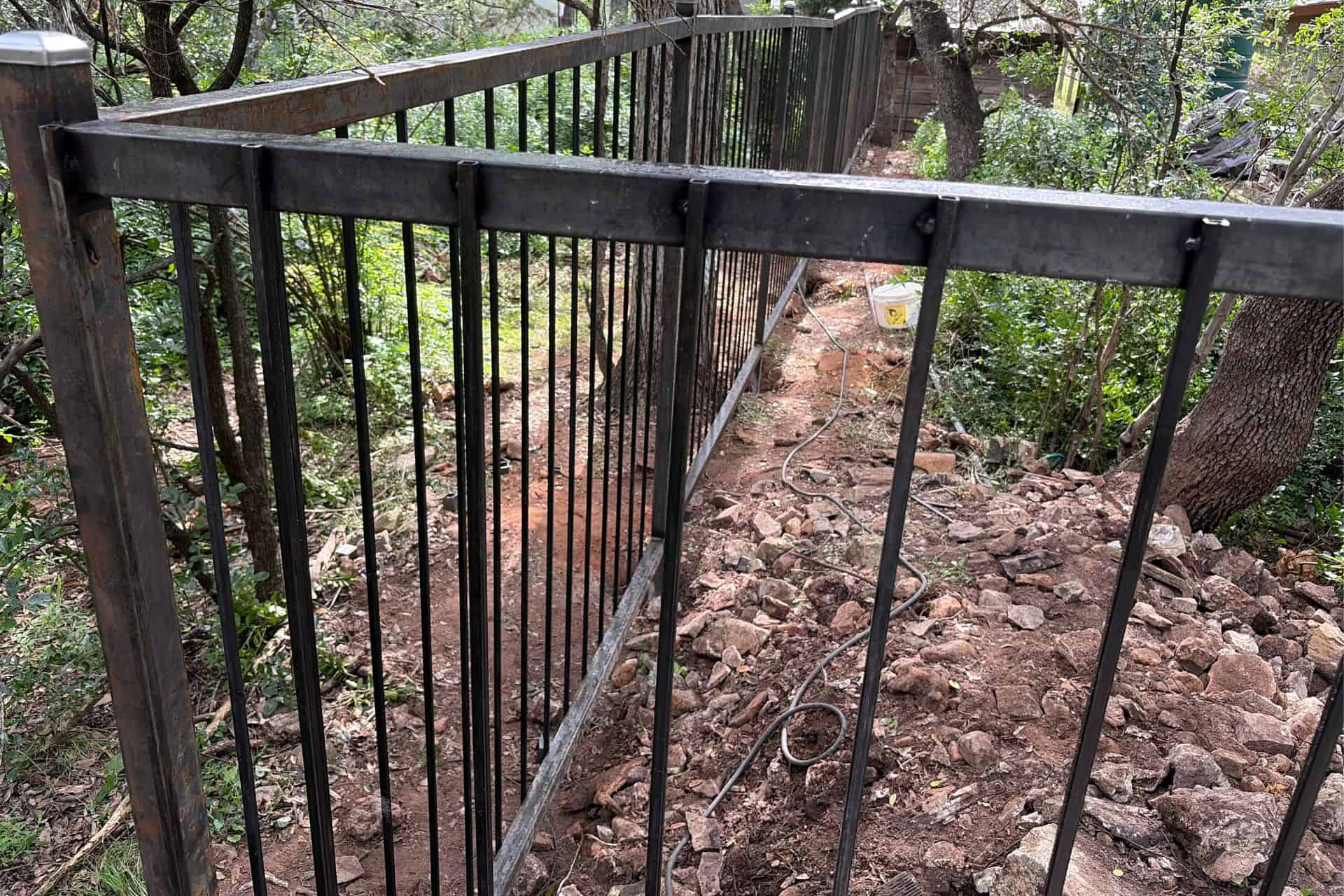
At Proud Steel Fence Co, we weld every fence on-site. That means we’ve set posts through limestone on hillside lots in Barton Creek, poured extra-deep footings in the clay soil common across Round Rock and Pflugerville, and custom-fabricated fence panels to follow the exact grade of sloped driveways throughout West Lake Hills and Dripping Springs. That terrain-specific knowledge is what separates a fence that lasts 30 years from one that leans in five.
What are the security advantages of a steel fence?
The strength of steel makes it extremely difficult to cut, bend, or breach — making it the superior choice for properties where security is paramount. That’s not a marketing claim. It’s a material property. A steel fence is a genuine physical deterrent in a way that wood privacy fencing is not.
For residential properties, the security advantages stack up across multiple dimensions:
Physical deterrence — A properly installed steel fence with spear-top or flat-top pickets is not easily climbed or breached. The weight and rigidity of heavy-gauge steel fabricated on-site — as opposed to lighter prefab panels — adds meaningful resistance to forced entry.
Visibility — Ornamental steel fencing is open by design. You can see your property from the street and your neighbors can see activity around your home. For families in Steiner Ranch, Rough Hollow, and the Lake Travis corridor, this visibility is a meaningful safety layer.
Access control integration — Steel fencing pairs naturally with automatic gates, keypads, phone-based entry, and camera systems in a way that wood fencing cannot support structurally. A steel perimeter with an automated entry gate gives you a complete, integrated security system rather than a decorative barrier.
Commercial security — For businesses across the Domain, South Congress, East Austin, and the Round Rock and Pflugerville commercial corridors, heavy-gauge steel security fencing is the industry standard for perimeter control. It withstands impact, resists cutting, and projects a professional, secured appearance that deters opportunistic intrusion.
Does steel fencing add curb appeal and property value in Austin?
Yes — and the effect is most pronounced in Austin’s mid-to-high value markets where buyer expectations are higher and architectural character matters.
A solid, attractive fence does three things buyers love: privacy, security, and that extra touch of curb appeal. Decorative metal fences offer a timeless, high-end look that, when paired with brick or stone posts, can elevate curb appeal and attract higher-end buyers.
In neighborhoods like Tarrytown, Rollingwood, Barton Creek, and Bee Cave, well-designed ornamental steel fencing is consistent with the architecture and price points of surrounding homes. A black powder-coated steel fence on a property in West Lake Hills or Rob Roy reads as a premium material that signals investment and care — the same way a quality front door or stone driveway does.
A quality fence installation increases security, privacy, and curb appeal — and a poorly designed or installed fence can lead to structural problems, damage, and a reduction in aesthetic appeal. The installation quality matters as much as the material. A steel fence fabricated on-site to the exact dimensions of your property, set with proper concrete footings, and finished with a quality powder coat will hold its appearance and structural integrity for decades. A prefab panel fence installed without accounting for your terrain and soil conditions will not.
In East Austin and Mueller, flat-top modern steel fencing has become one of the defining aesthetic markers of renovated and new-build properties. In Cedar Park, Leander, and Georgetown, ornamental steel for front yards and driveway gates is increasingly the upgrade that separates custom builds from production homes in the same neighborhood.
What are the low-maintenance advantages of steel fencing?
Maintenance is one of the most underestimated advantages of steel fencing, particularly over a 10 to 20-year horizon.
A cedar fence in Austin requires staining or sealing every two to three years to maintain structural integrity and appearance. Skip one cycle — which most homeowners do — and the degradation accelerates. Factor in board replacements, post repairs, and the full fence replacement most Austin wood fences need at the 12 to 15-year mark, and the “lower upfront cost” of wood disappears quickly.
Steel requires none of that. Metal fences do not require regular sanding, painting, or staining. Opting for powder-coated metal makes maintenance even easier since it’s resistant to peeling and flaking, even under the intense Texas sun. An annual rinse with a garden hose and an occasional inspection of welds and hardware is the full maintenance program for a properly installed steel fence in Austin.
At Proud Steel Fence Co, we weld every fence on-site — which means if a section ever needs attention from storm damage, a vehicle impact, or any other cause, we can return and repair the exact weld rather than replacing an entire panel. We cover the most common steel fence problems we see across Austin in more detail elsewhere — but that repairability is another long-term advantage that prefab systems simply can’t offer.
Is steel fencing a good choice for Austin’s HOA communities?
Yes — and it’s increasingly the preferred choice across Austin’s master-planned communities and HOA neighborhoods for exactly the same reasons it performs well in the broader market.
HOA communities have an obligation to maintain curb appeal and protect property values, ensuring that the neighborhood projects a uniform character and appearance. Ornamental steel fencing — particularly flat-top and spear-top styles in powder-coated black — is the style most commonly approved by HOA architectural review committees in Austin’s premium neighborhoods because it achieves that uniform, high-quality appearance consistently.
Communities across Cedar Park, Leander, Georgetown’s Wolf Ranch, Mueller, and the master-planned developments throughout Williamson County are increasingly specifying steel for perimeter fencing precisely because it holds its appearance over time without the maintenance burden that leads to HOA violations and neighborhood-wide degradation of fence quality.
Texas Senate Bill 711, effective September 2025, refined HOA fence law provisions, expanding board authority in some areas while reinforcing homeowner protections in others. Knowing what your specific HOA allows — and what the current Texas fence law framework requires — is part of what Proud Steel Fence Co handles for every project. We coordinate with your HOA’s architectural review process and ensure every installation meets both community standards and municipal code.
What are the fabrication advantages of on-site welded steel?
Steel can be welded, which allows for custom designs, repairs, and modifications that aren’t possible with other materials. That fabrication flexibility is what makes steel the right material for Austin’s varied terrain — and it’s what separates an on-site welding operation like Proud Steel from companies installing prefab panels from a catalog.
Prefab panels come in standard widths. Austin properties do not. When a prefab panel company encounters a sloped lot in West Lake Hills, a wooded lot with irregular post spacing in Lost Creek, or a property line with a complex corner configuration in Dripping Springs, the result is gaps, shimming, misaligned panels, and a fence that looks and performs worse than it should.
On-site welding eliminates all of that. At Proud Steel Fence Co, we measure your property, account for your terrain and grade, fabricate each section specifically for your post spacing and lot conditions, and weld it in place. Every joint is structurally sound. Every panel fits exactly. Every gate swings or slides with the geometry it was built for.
That’s not a differentiator we invented — it’s just the correct way to build a steel fence on Central Texas terrain, and it’s why properties across Barton Creek, Georgetown, Bee Cave, Kyle, and Buda have steel fences that perform the way they were designed to for decades.
What types of properties benefit most from steel fencing in Austin?
The honest answer is: almost all of them. But here’s how the advantages map to specific property types across the Austin metro:
Luxury residential (West Lake Hills, Barton Creek, Rob Roy, Rollingwood) — Estate-level ornamental steel, custom scroll designs, automatic entry gates. Steel is the standard material at these price points because buyers expect it and the terrain demands it.
Suburban new construction (Cedar Park, Leander, Bee Cave, Georgetown) — Steel for front yards and driveway gates, paired with wood or board-on-board for backyard privacy. A practical combination that maximizes curb appeal investment.
Urban residential (East Austin, Mueller, Travis Heights, Zilker) — Modern flat-top steel fencing fits the contemporary architectural aesthetic of Austin’s most rapidly appreciating neighborhoods. Clean lines, powder-coated black, low profile.
Acreage and Hill Country (Dripping Springs, Wimberley, Spicewood, Lake Travis corridor) — Long perimeter runs, custom ranch gates, remote access automation. Steel handles large-lot terrain that prefab systems can’t accommodate.
Commercial (Domain, South Congress, East Austin, Round Rock, Pflugerville) — Heavy-gauge security fencing, ornamental perimeter fencing for office parks, dumpster enclosures, access-controlled entry gates. Steel is the commercial standard.
HOA and multi-family (Mueller, Cedar Park, Leander, Round Rock, Georgetown) — Consistent appearance, low maintenance burden, long service life. Exactly what property managers and HOA boards need.
Advantages of Steel Fencing — Quick Reference
| Advantage | What It Means for Austin Properties |
|---|---|
| Longevity | 25–50 years vs. 10–15 for wood in Central Texas conditions |
| Low maintenance | No staining, sealing, or painting — annual rinse and inspection |
| Soil performance | Steel posts don’t rot or shift in Austin’s clay and limestone terrain |
| Heat & UV resistance | Powder coat holds color and integrity through 100°F+ summers |
| Security | Difficult to cut, bend, or breach — supports access control integration |
| Curb appeal | Consistent, premium appearance that holds over decades |
| Property value | Preferred by buyers in Austin’s mid-to-high value markets |
| Custom fabrication | On-site welding fits any terrain, grade, or lot configuration |
| HOA compatibility | Approved style in most Austin-area HOA communities |
| Repairability | Individual welds repaired on-site — no full panel replacement needed |
Frequently Asked Questions
What are the main advantages of steel fencing in Austin, Texas? Steel fencing in Austin offers superior durability in the heat and clay soil, minimal maintenance, genuine security strength, and long-term curb appeal that holds value over decades — all without the warping, rotting, and replacement cycles that affect wood fencing in Central Texas conditions.
Does steel fencing rust in Austin’s humidity? A properly powder-coated steel fence does not rust under normal conditions in Austin. The powder-coat finish creates a sealed moisture barrier. At Proud Steel Fence Co, every fence is welded on-site and finished with a quality powder coat — there are no exposed edges or weak points at connection joints.
How long do the advantages of steel fencing last in Austin? A properly installed powder-coated steel fence in Austin typically performs for 25 to 50 years. The operator systems on automated gates typically require service every 10 to 15 years depending on cycle frequency and maintenance. For more detail, read our post: How Long Does a Steel Fence Last in Austin, Texas?
Is steel fencing worth the cost in Austin compared to wood? Yes — when you factor in Austin’s climate, soil movement, and maintenance costs over a 20 to 30-year horizon, steel is consistently less expensive than wood despite the higher upfront cost. Our full cost comparison covers this in detail: Steel Fence vs. Wood Fence in Austin, Texas
Do I need a permit for a steel fence in Austin? Permit requirements depend on fence height, location on your property, and your specific municipality. Read the full breakdown: Do I Need a Permit to Build a Fence in Austin, Texas?
How much does a steel fence cost in Austin, Texas? Steel fence installation in Austin typically ranges from $30 to $55 per linear foot depending on style, height, and terrain. See current 2026 pricing: How Much Does a Steel Fence Cost in Austin, Texas?
See the Advantages of Steel on Your Property
Whether you’re fencing a new build in Cedar Park, upgrading a front yard in Tarrytown, securing a commercial property along the 130 Toll corridor in Round Rock, or building a custom gate system on a sloped lot in West Lake Hills — Proud Steel Fence Co brings 20 years of on-site welding expertise to every job across Travis, Williamson, and Hays counties.
We come to your property, assess your terrain and soil conditions, and build your fence on-site to fit exactly. No prefab panels shimmed to fit. No hidden fees. No subcontractors. Just owner-operated steel work built to perform in Central Texas for decades.
From Barton Creek and Rollingwood in the west, to Georgetown and Leander in the north, through Bee Cave, Lakeway, and Dripping Springs to the southwest, and down through Kyle and Buda in Hays County — Proud Steel Fence Co serves the full Austin metro.
Contact Proud Steel Fence Co for a Free Estimate →
Related posts from the Proud Steel blog:
How Much Does an Automatic Gate Cost in Austin, Texas?
How Much Does a Steel Fence Cost in Austin, Texas?
How Long Does a Steel Fence Last in Austin, Texas?
Steel Fence vs. Wood Fence in Austin, Texas — Which Is Worth It?
Why Do Fence Posts Fail in Austin, Texas?
Do I Need a Permit to Build a Fence in Austin, Texas?