
By the team at Proud Steel Fence Co | Serving Travis, Williamson & Hays Counties
Most fence repair problems don’t show up all at once — they start as something small that’s easy to ignore, and by the time it’s obvious, the repair is bigger and more expensive than it needed to be. A post that shifts half an inch in one wet season. A hinge that develops a little play. A rust spot near the ground that nobody notices until it’s eaten through the metal.
The purpose of this post is simple: help you identify what you’re actually seeing so you know whether it’s urgent, whether it’s something that can wait, and what it’s going to take to address it. Your fence is there for a reason — to protect your family, your pets, your property, and your privacy. Knowing when it’s not doing that job is worth paying attention to.
Leaning or Shifting Posts
This is the most common repair problem we see across Austin, and it’s also the one most likely to get worse if it’s left alone. A post that starts leaning puts stress on everything attached to it — rails, panels, gates, and the posts on either side. What starts as a single leaning post can become a failing fence line if the underlying cause isn’t addressed.
Post movement is typically caused by soil shifting, frost, corrosion, or water pooling at the base — and in Austin, soil is by far the biggest factor. The expansive Blackland Prairie clay that sits under Round Rock, Pflugerville, East Austin, and large parts of north Austin swells with moisture and contracts in the heat, creating a slow, cyclical force on fence posts that aren’t set deep enough to resist it. Over a few seasons, that movement adds up.
What to Look For
Walk your fence line and push on each post. A post that wobbles even slightly has lost its grip in the ground. If you can rock it by hand, the footing is already compromised — it’s not going to get better on its own.
Surface Rust and Corroded Welds
On steel fencing, rust shows up in two main places: near the ground where the post meets soil, and at weld points where the powder coat is thinnest or was nicked during installation. Lawn equipment — weed eaters and mowers — are the most common cause of coating damage at the base of a fence, and once that coating is compromised, the exposed steel starts oxidizing.
Many newer subdivisions are built with thinner, economy-grade metal that can rust quickly, especially at weld points or the bottom where sprinklers and weed eaters hit — and poor-quality coatings mean entire panels can deteriorate within just a few years. This is something we see in Cedar Park, Pflugerville, and parts of Georgetown where production builders used lighter gauge prefab panels to keep costs down.
What to Look For
Orange or brown staining on the metal surface, especially near the ground or at rail-to-post connections. Run your finger over a rust spot — if it wipes off and the metal underneath feels solid, that’s surface rust. If the metal feels soft, pitted, or flaky underneath, it’s gone deeper and that section needs to come out.
Sagging or Dragging Gates
A gate that doesn’t sit level, drags on the ground, or won’t latch properly is telling you something specific — either the hinges have worn out, or the post the gate hangs on has moved. Those two causes look similar from the outside but require different fixes, which is why getting the diagnosis right matters.
A gate that sags more after a rain and then improves slightly in summer is almost always a post problem — the clay soil expanding and pushing the post is the cause, not hinge wear. A gate that sags consistently regardless of season, especially if you can see the hinge pulling away from the post, is a hinge problem.
What to Look For
Check the post first — push it side to side and see if it moves. If it’s solid, look at the hinges. If either hinge has visible play, is pulling away from the post, or has a gap between the hinge plate and the metal, that’s your problem. We go deeper on this specific diagnosis in our post on why steel gates sag in Austin.
Bent or Damaged Rails and Panels
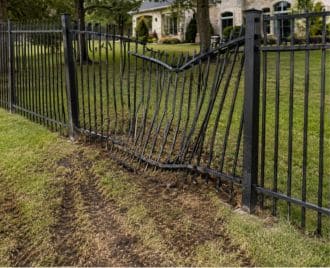
Impact damage is straightforward to identify — a vehicle backed into the fence, a storm threw debris into it, a tree branch came down on it. The damage is usually visible and contained to a specific area. What’s less obvious is whether the impact also affected the posts on either side, which can be stressed or pushed slightly even when the panel absorbed most of the impact.
Steel is repairable in a way that wood and vinyl simply aren’t — a bent section can be cut out and replaced with a matching piece, welded in place and finished to match. The repair is often invisible once it’s done. For a sense of what this typically costs, our breakdown of steel fence repair costs in Austin covers bent rail replacement specifically.
What to Look For
Any section where rails are visibly bent, panels have shifted out of line, or pickets are pushed inward or outward. Also check the posts on either side of the impact area — push them to confirm they haven’t moved.
Gate Hardware Failure
Latches, drop rods, and hinge hardware wear out faster than the gate itself, especially on gates that cycle multiple times a day. This is normal wear, not a sign of a bad installation — it’s just the nature of moving parts. The problem is when worn hardware goes unaddressed long enough to stress the gate frame or the post it hangs on.
A latch that doesn’t catch properly is a security gap. A drop rod that won’t seat in its sleeve means the gate can swing freely when it should be locked in place. These are small repairs when they’re caught early and bigger problems when they’re not.
What to Look For
Test the latch every time you use the gate — it should catch firmly without lifting or forcing. Drop rods should slide freely into their ground sleeves and hold without wobbling. Any resistance or looseness is worth addressing before it becomes a gate that won’t secure at all.
Storm Damage
Austin gets serious weather — summer thunderstorms, hail, and occasional high-wind events that can bend panels, knock posts out of plumb, or send debris into a fence line. Storm damage is usually obvious, but what’s less obvious is whether sections that look fine also took stress from the event.
What to Look For
After any significant storm, walk the full fence line — not just the sections that obviously took a hit. Push each post. Check all gates for alignment. Look at weld points on panels that were near the damage. A section that looks fine from ten feet away can have a stress fracture or a compromised post that shows up as a bigger problem three months later.
Frequently Asked Questions
How do I know if my fence problem is urgent?
If a gate won’t close and secure properly, or if a section of fence has completely fallen or been breached, that’s urgent — your property is unsecured. Leaning posts, surface rust, and worn hardware are serious but can typically be scheduled rather than emergency repairs.
Can I inspect my own fence for problems?
Yes — walking the fence line and pushing on each post takes about ten minutes and will catch most structural issues early. Look for rust spots near the ground, check gate alignment, and test latches and drop rods.
Is it worth repairing an older steel fence?
Usually yes, if the damage is isolated. Steel fencing that was installed correctly and is in otherwise good condition can be repaired section by section for a fraction of replacement cost. The calculus changes if the same problems keep showing up in multiple places.
Do you diagnose fence problems before quoting the repair?
Yes, every time. We come to the property, look at the actual fence, and tell you what we find before any work is quoted or started. We don’t give estimates over the phone for repair work because the phone call doesn’t tell us what’s actually wrong.
If you’re seeing any of these problems on your property and want a straight answer on what it would take to fix them, reach out for a free repair assessment and we’ll come take a look. We serve homeowners and businesses across Austin — from West Lake Hills and Barton Creek to Round Rock, Cedar Park, and Georgetown, down through Bee Cave, Dripping Springs, Kyle, and Buda.