
By the team at Proud Steel Fence Co | Serving Travis, Williamson & Hays Counties
How to choose the right fence company in Austin is one of the most important decisions in a fencing project — and it’s one most homeowners make without enough information. The estimate looks fine. The price seems reasonable. And then six months later the posts are leaning, the gate won’t close, and the company isn’t returning calls.
Your fence is protecting your family, your pets, your property, and your privacy. The company you hire determines whether that protection holds up for 30 years or falls apart in three. Here’s what to actually look for before you sign anything.
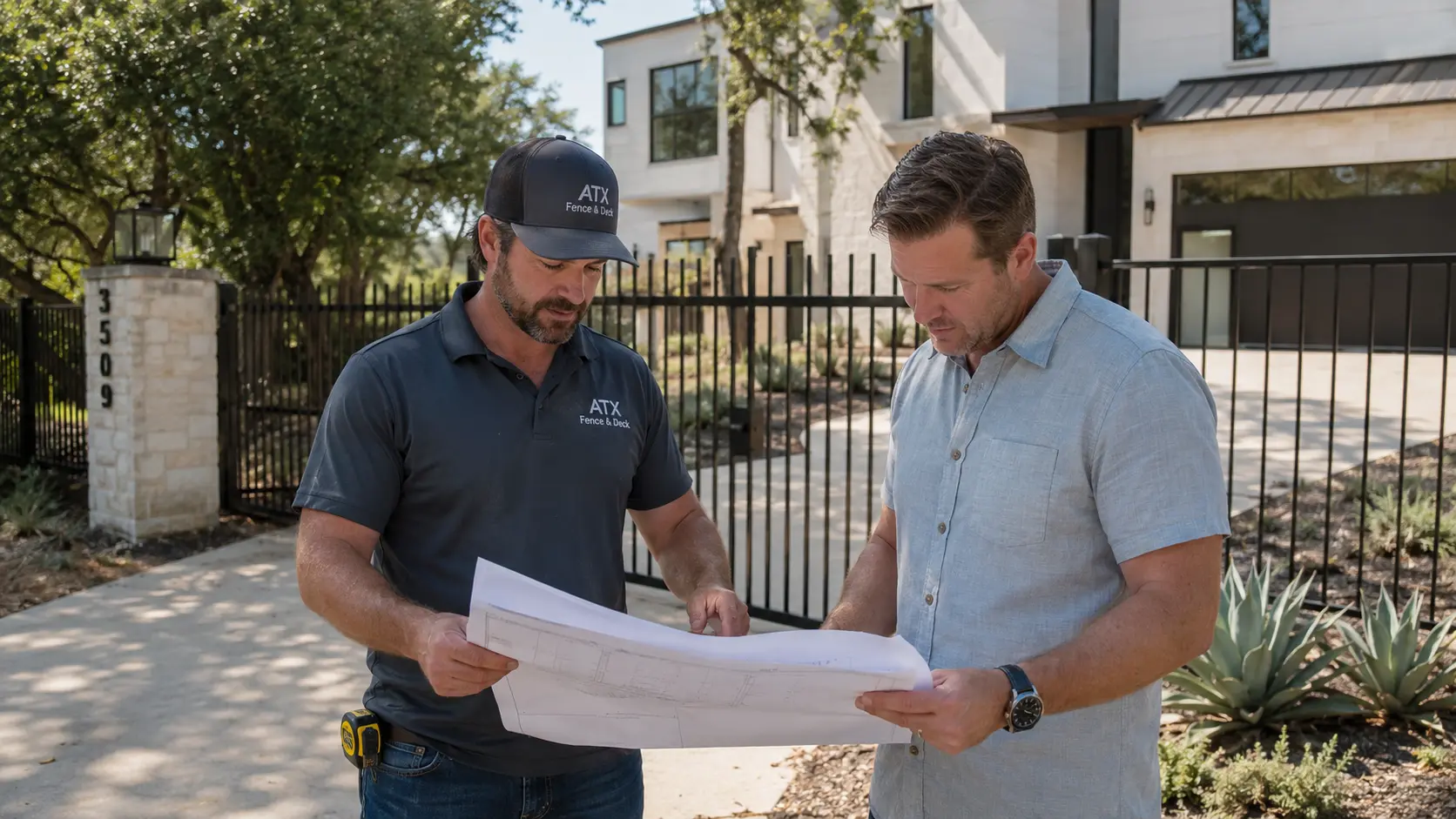
Do They Come to Your Property Before Quoting?
This is the first and most important filter. A fence company that quotes your job from a phone call, a satellite image, or a website form has not assessed your actual property. They don’t know what’s under the ground. They don’t know how your soil behaves in a wet season. They don’t know the grade of your driveway or where your property line actually falls.
Austin’s terrain makes this non-negotiable. Properties in West Lake Hills, Barton Creek, and Rob Roy sit on limestone caliche that can be inches from the surface. Properties in Round Rock, Pflugerville, and East Austin sit on expansive Blackland Prairie clay that moves with every rain cycle. A contractor who quotes without seeing your specific site has not accounted for any of this — and that gap between their estimate and reality will show up somewhere, either in the quality of the installation or in a change order mid-project.
Any company worth hiring will come to your property, look at the terrain, check for grade changes, note where gates need to go, and assess the soil before they put a number on paper. If you want to understand what that process should look like in full, our post on what professional fence installation includes walks through every step. If they won’t do a site visit, move on.
Are They Licensed and Insured in Texas?
In Texas, you can verify a fence contractor’s licensing status through the Texas Department of Licensing and Regulation, and any legitimate contractor should be able to provide proof of general liability and workers’ compensation insurance on request.
This matters for one straightforward reason: if something goes wrong during installation — a utility line gets hit, a worker is injured, a vehicle is damaged — your homeowner’s insurance shouldn’t be the one covering it. A contractor without proper insurance puts you in that position, even if it’s their mistake.
Ask for their license number and insurance certificate before the contract is signed. A professional company will provide both without hesitation. A company that hedges or makes excuses about this is a red flag regardless of how good their quote looks.
Do They Understand Austin’s Soil and Terrain?
This is where you can quickly separate contractors who actually know what they’re doing from ones who are learning on your job. Ask them directly: what do you do differently for properties with limestone? How deep do you set posts in clay soil? How do you handle a sloped driveway when installing a gate?
A contractor who has worked across this market — from the Hill Country corridor out west to the Blackland Prairie clay neighborhoods east of I-35 — will answer these questions specifically. They’ll talk about post depth requirements in clay, about drilling through caliche, about why dry-poured concrete fails in Austin’s soil. A contractor who gives generic answers hasn’t actually dealt with these conditions enough to have opinions about them.
For a steel fence specifically, ask whether they fabricate on-site or install prefab panels. On-site fabrication means every section is built for your property’s exact dimensions, grade, and gate spacing. Prefab panels are built to standard sizes and don’t accommodate Austin’s varied terrain the way custom on-site work does — which is exactly why so many of the repair calls we get involve fences where prefab panels were installed on properties that needed custom work.
What Does the Estimate Actually Include?
A professional estimate for a steel fence installation should be itemized. It should specify the linear footage, fence height, gate count and type, steel gauge and finish specification, post setting method and concrete mix, whether permits are included, and a clear project timeline.
If an estimate arrives as a single lump sum — “$8,500 for your fence” with no breakdown — ask for itemization before you sign. A contractor who can’t break down their own quote doesn’t have full visibility into their costs, and that uncertainty has to resolve somewhere. It usually resolves as a change order, a corner cut on materials, or a post that goes in at the wrong depth because the budget didn’t account for Austin’s actual soil conditions.
Also ask specifically whether permit fees and HOA submission costs are included in the quote or billed separately. These are real costs that can add $150 to $400 to a project, and they’re easy to exclude from an estimate to make a number look lower than it actually is.
What Happens After the Job Is Done?
A warranty is only useful if the company is still around to honor it. Ask how long they’ve been operating in Austin, whether they have verifiable reviews from Austin-area customers, and what their process is if something goes wrong after installation.
The difference between a company that sells a job and hands it to a subcontractor and one that has the owner on every site is a significant one. When the person who quoted the job is also the person who builds it — and the person you call if something needs attention afterward — accountability is built into the process rather than negotiated after the fact.
At Proud Steel Fence Co, Richard quotes every job and builds every job. There’s no sales team passing work to a crew that’s never seen your property. That’s not a marketing line — it’s the operational difference between a company that stands behind its work and one that hopes you don’t call.
Red Flags Worth Walking Away From
A few things that consistently signal trouble before a contract is signed:
A quote that’s dramatically lower than every other estimate. Steel is steel — there’s a real cost to quality material and professional fabrication. A quote that’s 40% lower than competitors is either using lighter gauge material, cutting corners on post setting, or planning to recover the margin somewhere you haven’t seen yet.
No site visit before quoting. Covered above — but worth repeating. If they won’t look at your property, they’re not pricing your actual job.
Pressure to sign quickly. A professional company will give you time to think. Urgency tactics — “this price is only good today,” “we have another customer ready to take this slot” — are sales pressure, not signs of a well-run operation.
Vague answers about materials. If they can’t tell you the gauge of the steel, the type of concrete mix, or the post depth specification, they haven’t thought through the details of your project.
No verifiable local reviews. Asking for references or checking Google reviews for Austin-area jobs specifically tells you a lot. A company that has done good work in this market will have customers who’ll say so.
Frequently Asked Questions
How many estimates should I get for a fence job in Austin?
Three is a reasonable number. It gives you enough data to understand the market rate and spot estimates that are suspiciously high or low, without spending weeks in back-and-forth with contractors.
Should I choose the lowest estimate?
Not automatically. The lowest estimate often reflects a lower material spec, a less experienced crew, or a company that hasn’t accounted for site-specific conditions. Focus on what the estimate includes rather than the total number.
Do fence companies in Austin handle permits?
Some do, some don’t. Ask specifically before signing anything. A company that handles permits as part of their service is easier to work with than one that leaves you to navigate the City of Austin permitting process on your own.
What’s the difference between a fence installer and a steel fabricator?
A fence installer hangs pre-made panels between posts. A steel fabricator — like Proud Steel — measures your property, cuts the steel to match, and welds every section on-site. For properties with slopes, irregular lot lines, or custom gate configurations, fabrication is what produces a fence that actually fits.
If you’re in the process of evaluating fence companies in Austin and want a straight answer on what your project involves and what it should cost, reach out for a free on-site estimate and we’ll come take a look. We serve the full Austin metro across Travis, Williamson, and Hays counties — from West Lake Hills and Barton Creek to Cedar Park, Round Rock, and Georgetown, down through Bee Cave, Dripping Springs, and Kyle.