
By the team at Proud Steel Fence Co | Serving Travis, Williamson & Hays Counties
A fence that’s settling or shifting in Austin is almost never a fence problem — it’s a soil problem, and the fence is just the first thing you notice. We get this call constantly from homeowners across Round Rock, Pflugerville, East Austin, and Leander — and the answer is almost always the same: Austin’s clay soil is doing what Austin’s clay soil does, and the fence wasn’t installed to handle it.
Here’s what’s actually happening and what it takes to fix it properly.
Why Austin Fences Settle and Shift
The soil underneath most of the Austin metro is expansive Blackland Prairie Vertisol — a heavy clay that contains minerals which cause it to swell dramatically when wet and shrink and crack when dry. Expansive clay soil in Central Texas can change volume by up to 30% between saturated and dry states, and that movement doesn’t happen gently. It pushes on concrete footings, heaves posts upward, and pulls away from post bases during dry spells, leaving gaps and voids where there was once solid ground contact.
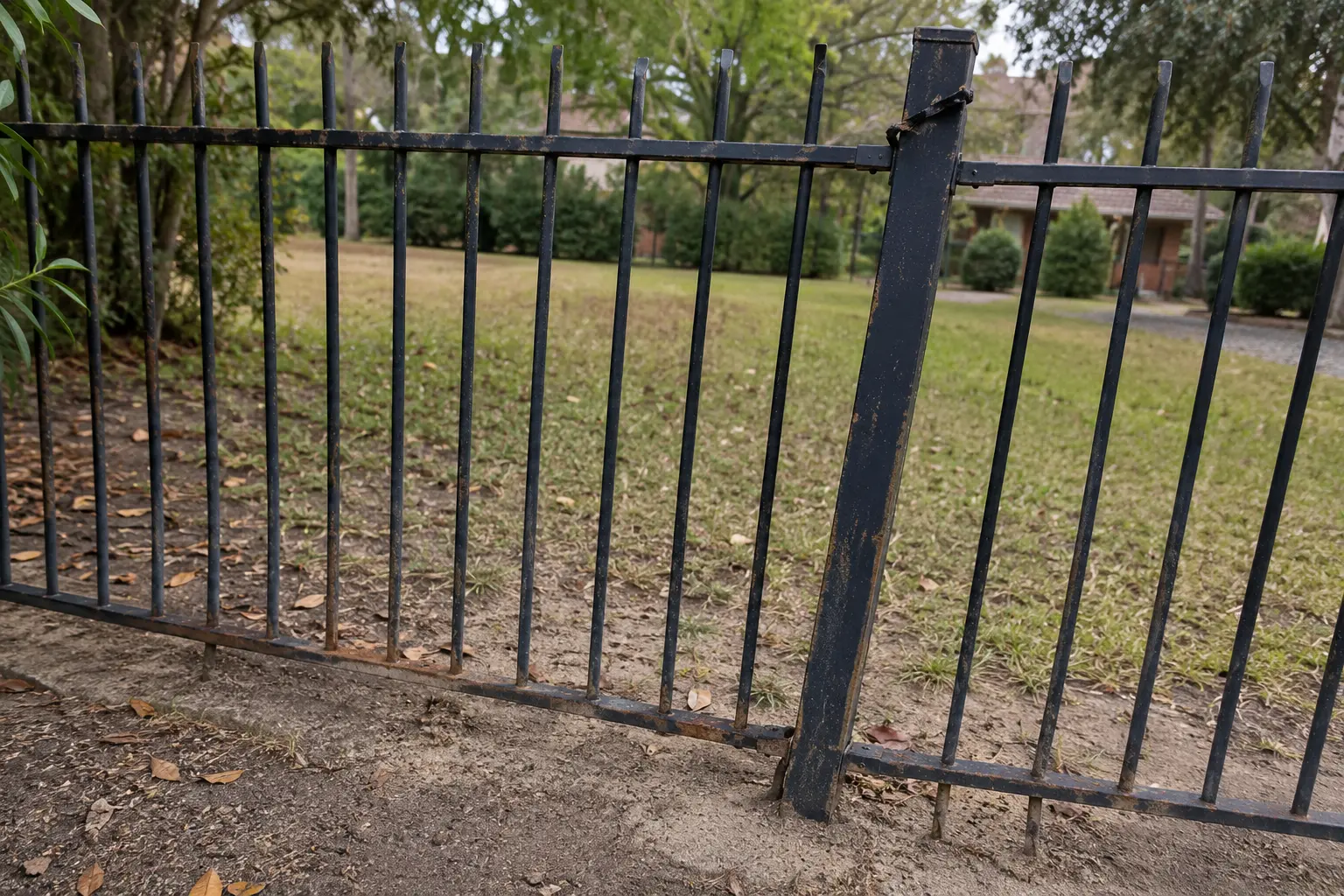
A fence post that was perfectly plumb the day it was installed can be visibly leaning after a single Austin wet season followed by a summer drought. And the problem compounds — each cycle of expansion and contraction moves the post a little further, until the lean is significant enough that the gate won’t close or the fence panels start pulling apart at the joints.
Out in West Austin — West Lake Hills, Barton Creek, Lakeway, and Bee Cave — the soil challenge is different. Limestone sits close to the surface, sometimes within 12 to 18 inches. Posts that weren’t drilled deep enough into that rock will eventually shift under lateral load, especially on properties with sloped driveways where gate posts carry both the weight of the gate and the stress of its daily swing.
How to Tell If Your Fence Is Settling or Shifting
The most reliable test is the one we use on every site visit. Walk your fence line and push firmly on each post — not the panels, the actual post itself. A post that wobbles, rocks, or moves even slightly has lost its grip in the ground. The footing is compromised.
A fence that’s settling will often show multiple signs at once: panels that are no longer level, gate frames that have pulled slightly out of square, and rails that have started to pull away from post connections. These aren’t three separate problems — they’re three symptoms of the same underlying cause, which is a post that has moved.
What looks like a panel problem or a gate problem is almost always a post problem. Fixing the gate without addressing the post just means you’re back to square one when the next wet season hits.
What the Fix Actually Looks Like
The right fix for a fence that’s settled or shifted in Austin’s soil is a post reset — not a brace, not a patch, not wedging gravel around the base. Those approaches slow the symptom. A post reset addresses the cause.
Here’s what we do:
We dig out the failed post and remove the old concrete footing completely. In Austin’s clay, partial removal isn’t sufficient — the old footing has already been compromised by soil movement and doesn’t provide a stable base for a reset. We remove it and start fresh.
We set the new post deeper than the original. In Texas clay soils, posts should be set at least 36 to 48 inches deep to get below the active clay zone where the most movement occurs. Many of the failing posts we dig out were set at 24 inches — adequate in most soil conditions, inadequate in Austin’s expansive clay.
We add a gravel drainage layer at the base of the hole before the post goes in. This is the step that gets skipped most often on standard installations. Water that pools at the base of a post footing is one of the main drivers of footing failure in clay — gravel allows it to drain away from the footing rather than sitting against it through a wet season.
We pour properly mixed concrete — not dry-poured mix. Dry-poured concrete that relies on ground moisture to cure produces inconsistent results in Austin’s clay, particularly in dry conditions where the soil doesn’t provide enough moisture for a proper cure. We mix and pour, every time.
Once the concrete has cured, we reattach the fence panels and re-hang and align any gates. The repair holds because the cause has been addressed, not just the symptom.
Can You Repair Just the Worst Posts or Do They All Need to Come Out?
This depends on what we find when we assess the full fence line, and it’s a question worth asking honestly before any work starts.
If one post has failed and the adjacent posts are solid — push test, no movement — the repair is contained. We reset the one post that’s failed and the fence line stabilizes.
If multiple posts are showing movement, even slight movement, that changes the picture. A post that’s moving slightly today is going to be the next call in a year. In that situation we’d rather tell you upfront that two or three posts need attention than reset one and send you an invoice, only to be back in twelve months for the next one.
We cover the broader decision framework — when to repair individual posts versus when full fence replacement makes more sense — in our post on why fence posts fail in Austin, Texas.
What About Gates That Have Shifted?
A gate that won’t close, latch, or swing smoothly after a fence has settled is almost always a post problem, not a gate problem. The gate panel itself is usually fine — it’s the post it hangs on that’s moved enough to throw off the geometry.
Trying to fix a shifted gate by adjusting hinges or replacing the latch is fighting the symptom. Once the post is correctly reset, the gate usually goes back into alignment on its own, or needs only minor hinge adjustment to close and latch properly again. Our mobile welding and repair team handles both the post work and the gate realignment in the same visit so you’re not dealing with two separate contractors on the same job.
How Long Before a Reset Post Is Stable?
We typically allow 24 to 48 hours for the concrete footing to cure before we reattach fence panels and rehang gates. For heavier gates — particularly double-swing estate gates or automated slide gates — we prefer to wait the full 48 hours before putting load on the new footing.
After the repair, the post should be stable through Austin’s normal soil movement cycles indefinitely, provided it was set at the correct depth and with adequate drainage. That’s the standard we hold ourselves to — not a patch that lasts a season, but a fix that holds for the life of the fence.
Frequently Asked Questions
How do I know if my fence is settling from soil movement or something else?
Soil movement produces a predictable pattern — posts that lean, panels that go out of level, and gates that shift out of alignment, usually following wet seasons. Impact damage from vehicles or storms looks different — localized, sudden, and often confined to one section rather than spread across a fence line. If your fence problems seemed to develop gradually over months rather than appearing after a specific event, soil movement is almost certainly the cause.
Can I fix a settling fence post myself?
A slight lean on a light fence with shallow posts can sometimes be corrected with post spurs or wedging — but in Austin’s clay soil, that’s usually a temporary fix. A proper reset requires removing the old footing, setting the post to the correct depth, and using properly mixed concrete. It’s doable for someone with the right tools and experience, but getting the depth and drainage wrong means repeating the job in a few years.
Will the repaired section match the rest of my fence?
Yes. We reattach the existing fence panels and gate hardware to the reset post, so nothing changes visually once the repair is complete. The only difference is a post that holds.
How much does a fence post reset cost in Austin?
A single post reset typically runs $300 to $600 depending on soil conditions, post depth required, and whether gate realignment is involved. Properties in West Austin with limestone terrain may run higher due to drilling requirements. Our full cost breakdown is in our post on steel fence repair costs in Austin.
If your fence is settling or shifting and you want a straight answer on what it would take to fix it, reach out for a free on-site assessment and we’ll come walk the fence line with you. We serve the full Austin metro — from West Lake Hills and Barton Creek to Cedar Park, Round Rock, and Georgetown, down through Bee Cave, Dripping Springs, Kyle, and Buda.
👉 proudsteelfenceco.com/mobile-welding-fence-repair-austin-tx