By the team at Proud Steel Fence Co | Serving Travis, Williamson & Hays Counties
When someone asks us whether they should go with pre-made panels or custom steel fencing, the honest answer is: it depends on your property, and we’ll tell you straight which one makes sense for yours. We’re not going to pretend custom is always the right call just because that’s what we do. But we’ve also seen what happens when someone puts prefab panels on a property where they don’t belong, and it’s worth knowing the difference before you spend the money.
What’s the Real Difference Between the Two?
Pre-made panels are built somewhere else, in standard sizes, and then brought to your property to be set between posts. Custom steel fencing is measured, cut, and welded right on-site, built specifically for your property’s exact dimensions.
That sounds like a small difference, but it changes everything about how the fence fits. Pre-made panels come in standard widths and are built for straight, level ground, and they install faster because most of the work is already done before they show up. Custom fencing takes longer because every section is built to match your property — but that’s also the whole point.
When Pre-Made Panels Actually Make Sense
We’re going to be straight with you here, because we think it matters. If your property is flat, your fence line is mostly straight, and budget is the main thing driving the decision, pre-made panels aren’t a bad option. They’re faster to install, and on the right property, they can look perfectly fine.
We’ve seen this work well on smaller backyard sections in places like Pflugerville and parts of Round Rock where the lot is flat, square, and the fence line doesn’t have to deal with much beyond a couple of corners. If that’s your situation and you’re working with a tight budget, we wouldn’t talk you out of it.
Where Panels Start to Show Their Limits
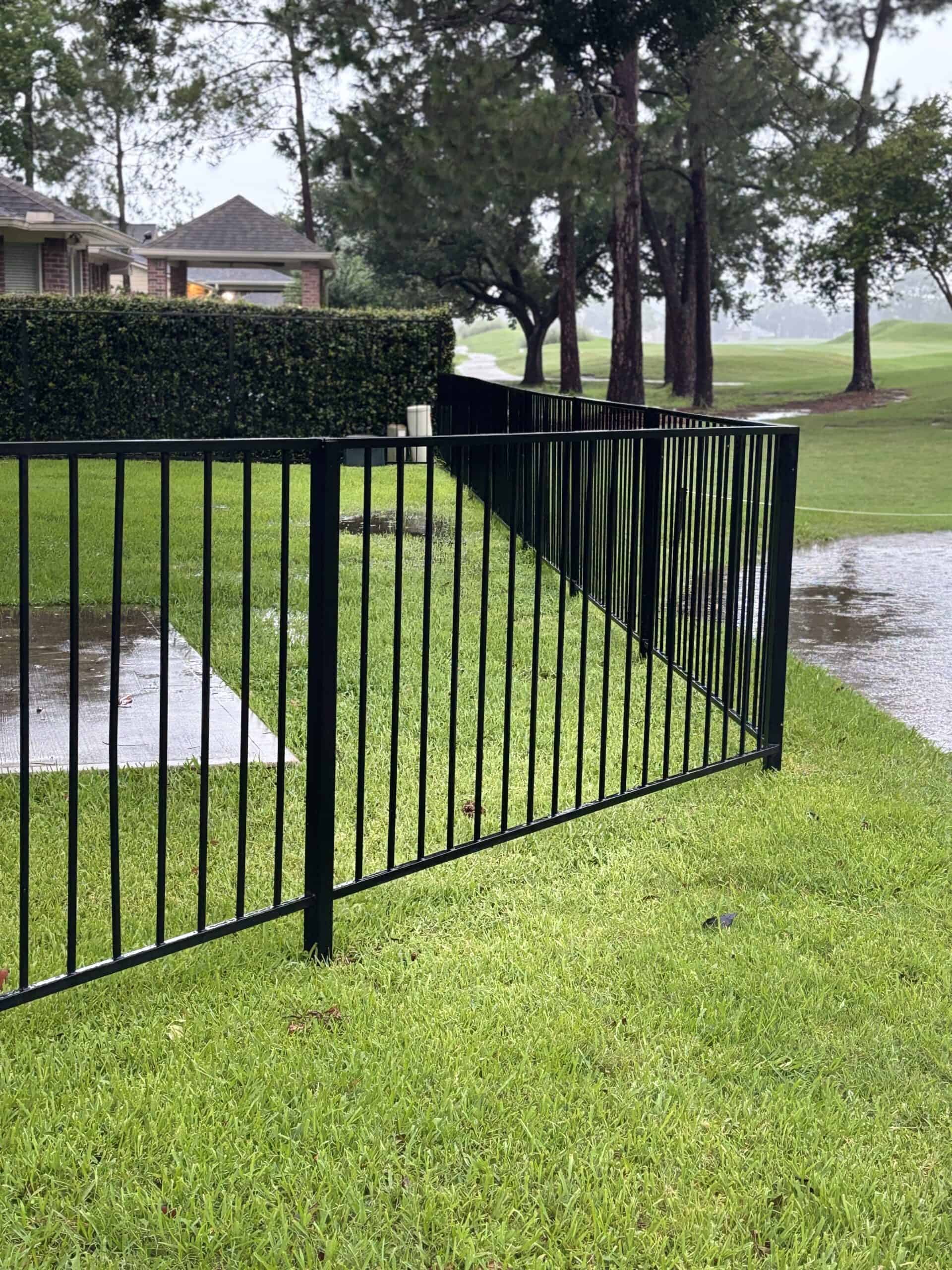
The problem is that most properties aren’t perfectly flat and square — especially around here. Rackable panels can adjust to slopes up to a certain degree without custom cutting, but once a slope gets steeper than that, or the ground has dips and rises that change every few feet, panels start to fight the terrain instead of following it. You end up with gaps at the bottom, panels that step awkwardly down a hill, or posts that don’t line up the way they should.
We also want to be honest about something else: a lot of the prefab panels sold at big box stores are made with thinner materials to keep the price down. They can look fine on the showroom floor, but they don’t hold up the same way over time, especially with the heat and soil movement we deal with in Austin.
Why Custom On-Site Welding Is the Better Fit for Most Austin Properties
Here’s our honest opinion, and it’s based on 20 years of doing this work: most properties in the Austin area have something — a slope, an angle, a tree, a gate that needs to line up just right — that makes custom the better choice. Not because custom is fancier, but because it actually solves the problems those properties have.
When we weld a fence on-site, we’re not trying to make your property fit a panel that was built for flat ground somewhere else. We measure your property, account for the slope and the layout, and build each section to match. If your fence line dips and rises along the way, the fence follows that line instead of stair-stepping down it with gaps underneath.
This matters most in places like West Lake Hills, Barton Creek, Rob Roy, and out toward Dripping Springs, where the lots are rarely flat and the soil underneath is often rocky limestone that doesn’t behave the same way everywhere on the property. We’ve built custom steel fencing on lots where no two sections were the same length, because that’s just what the property called for.
What This Looks Like for Gates
This is where the difference really shows up. A driveway gate has to match the exact width and grade of your driveway entrance — there’s no “standard size” that works for every property. We’ve fixed gates before that were installed using prefab components on a slope, and the gate either dragged on the ground or left a gap big enough for a dog to squeeze through. If that sounds like what you’re dealing with right now, it’s one of several common steel fence problems we see across Austin properties. When we build a gate on-site, it’s built for that specific opening, on that specific grade, the first time.
How Much More Does Custom Cost?
This is the part people want a straight number on, and we get it. Custom steel fencing does cost more than prefab panels — there’s more labor involved, and every section is made specifically for your property instead of being mass-produced.
But the gap isn’t always as big as people expect, and here’s why: with prefab panels, you’re often paying for materials and labor to deal with the problems the panels create on a sloped or irregular lot — extra cuts, extra hardware, extra time fighting the terrain. With custom, that work is just part of how it’s built from the start.
Welded mesh panel systems with heavier gauge steel and powder coating typically run in a higher range than basic chain-link, and custom ornamental work goes up from there depending on style and complexity. The real answer is that it depends enough on your specific property that we’d rather come look at it and give you real numbers than throw out a range that might not mean much for your situation.
How Do I Decide Which One Is Right for My Property?
Honestly, the easiest way is to think about your property in a few simple terms:
- Is your fence line mostly flat and straight, or does it have slopes, angles, or curves?
- Does the soil on your property hold steady, or have you noticed posts leaning or shifting on existing fences?
- Are you installing a gate, and if so, does the driveway have any grade to it?
- How long do you want this fence to last without thinking about it again?
If your answers point toward flat, straight, and budget-focused, panels might be the right call, and we’d tell you that. Either way, choosing the right fence company in Austin matters as much as choosing the right material. If your property has any complexity to it at all — which describes a lot of what we see across Travis, Williamson, and Hays counties — custom is almost always going to serve you better in the long run.
Frequently Asked Questions
Can pre-made panels be used on a sloped lot?
To a point. Some panels are designed to rack, or angle slightly, to follow a gentle slope. But once the slope gets steep enough — which is common in the Hill Country areas around Austin — panels start leaving gaps or sitting unevenly, and that’s when custom becomes the better option.
Is custom steel fencing worth it for a small backyard?
It depends on the yard. If it’s flat and simple, probably not — panels would do the job fine. But if there’s any irregular shape, a gate, or a slope involved, even a small custom job often ends up looking and performing better than panels would.
Will custom fencing take longer to install than panels?
Yes, generally. Panels are pre-built before they arrive, so installation is mostly setting posts and hanging panels. Custom fencing involves measuring, fabricating, and welding on-site, which takes more time but means everything is built to fit.
Can I mix panels and custom sections on the same property?
In some cases, yes — for example, panels along a flat back stretch and a custom-built section around a gate or a tricky corner. We’d need to look at the property to say whether that makes sense for your situation specifically.
If you’re trying to figure out which option fits your property, the best thing to do is have us come take a look and give you a straight answer — not a sales pitch either direction.