
By Richard Burdick, Owner at Proud Steel Fence Co | Serving Travis, Williamson & Hays Counties
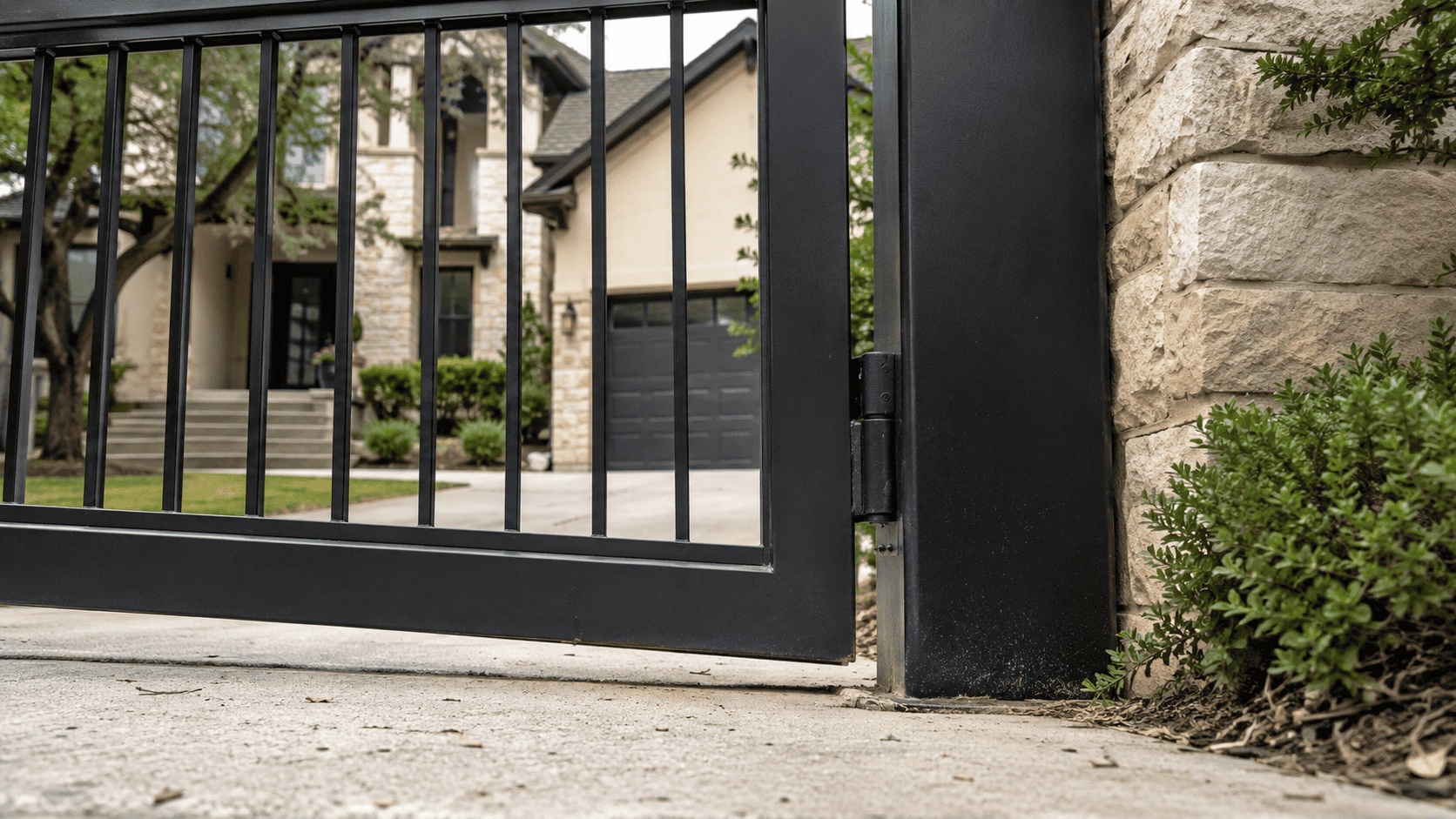
If your steel gate is sagging, you’re not alone. This is one of the most common calls we get from homeowners all across Austin. And here’s the good news right away: most of the time, it’s fixable. You don’t need a whole new gate. You just need to know what’s actually causing it.
We’ve been welding gates and fences here for 20 years. We’ve seen this problem on driveways in Round Rock, on estate gates out in Barton Creek, and on small walk gates in East Austin backyards. A sagging gate is just one of several common steel fence problems we run into across Austin, but the cause behind this one is almost always one of two things. Let’s walk through it.
What causes a steel gate to sag?
A sagging gate almost always comes down to one of two problems: the hinges are worn out, or the post has moved — and both of these fall into the broader category of common steel fence problems we deal with regularly across Austin. Hinges wear out, bend, or pull loose from posts over time, and heavy gates make that wear happen faster. If the hinges are tight and the gate still droops, the post itself is the problem.
Think of your gate like a door. If the door hinges are loose, the door drags. If the door frame itself has shifted, the door won’t close right no matter how good the hinges are. A steel gate works the same way. Hinges first. Posts second. That’s the order we check every time.
Is it the hinges or the post? Here’s how to tell
If your gate drags on the ground but the post still looks straight and tight in the ground, it’s probably the hinges. If the whole post is leaning — even a little — that’s your real problem, and tightening the hinges won’t fix it for long.
Here’s a simple test. Grab the gate post with both hands and push it side to side. If it wobbles or shifts in the ground, the post has moved. Fence posts in Austin lean for a handful of reasons — shifting clay soil, the post not being set deep enough to begin with, wind, water pooling at the base, or rot if it’s a wood post. For a steel gate, soil movement is by far the biggest one.
Why does Austin soil cause gate posts to lean?
Austin sits on soil that moves. A lot of the city — Round Rock, Pflugerville, parts of East Austin and Manor — has what’s called Blackland Prairie clay. Leaning posts are Austin’s most common fence failure, and it’s almost always the same cause: the post was set too shallow in clay soil that expands when it rains and shrinks when it dries out.
We’ve seen this play out the same way over and over. A post gets set in dry summer soil. That soil is shrunk down and hard. Then fall and winter come, the rain soaks in, and that clay swells up — sometimes by inches. It pushes on the post. Then summer comes back, the soil dries and shrinks again, and now there’s a gap around the post that wasn’t there before. Every cycle, the post moves a little more. After a few years, you’ve got a gate that won’t close.
Out west — West Lake Hills, Barton Creek, Rob Roy — the soil is different. It’s rocky, limestone, caliche. Posts set in that ground don’t move from clay expansion, but if they weren’t drilled deep enough into the rock to begin with, they can still shift under the weight of a heavy steel gate over time.
Either way, the fix starts at the same place: the post.
Can a sagging steel gate be fixed without replacing the whole thing?
Yes — almost always. A sagging gate is commonly fixed by resetting the post with a new footing, or by repairing and replacing the hinges, depending on which one has failed. A full gate replacement is rarely the answer.
Here’s what we actually do on a job like this. If it’s the hinges, I replace them with heavy-duty hinges built for the weight of your gate — a lot of the original hinges I see were never rated for the gate they’re holding up in the first place. If it’s the post, I dig it out, reset it at the proper depth, and pour a new concrete footing that’s sized for Austin soil, not just whatever the minimum was. Then I rehang the gate, level it, and adjust it so it swings and latches the way it should.
If it’s a steel gate we built ourselves, even better — we know exactly how it was put together, so we can match the repair to the original work instead of guessing.
What does it cost to fix a sagging gate in Austin?
Gate repairs tend to cost more than other fence repairs because gates have moving parts — hinges, latches, and hardware that wear out, rust, or loosen over time. A simple hinge swap might run you a couple hundred dollars. A full post reset with a new concrete footing costs more, but it’s still a fraction of replacing the whole gate. If you’d rather see typical numbers up front, check out our Mobile Welding & Repair page for more on how we handle on-site fixes.
We don’t like giving a number over the phone for this kind of work, and here’s why — every situation is different. A small walk gate hinge fix in East Austin is a totally different job than resetting a heavy double-swing estate gate out in Barton Creek. We’ll come out, look at it, tell you straight what’s wrong, and give you a real number before any work starts. No surprises, no upsells.
Quick Reference — Common Causes and Fixes
| What You’re Seeing | Likely Cause | Typical Fix |
|---|---|---|
| Gate drags but post looks straight | Worn or loose hinges | Replace with heavy-duty hinges rated for the gate’s weight |
| Whole post leans or wobbles | Post moved in clay soil | Dig out, reset post, pour new concrete footing |
| Gate sags more after rain | Clay soil swelling around post | Reset post deeper with proper footing |
| Automatic gate grinding or stalling | Misaligned gate from a leaning post | Fix post and hinges first, then check operator |
| Gate was fine, now won’t latch | Hinges and latch no longer line up | Realign hinges, adjust or replace latch hardware |
What if it’s an automatic gate that’s sagging?
If your gate is automated, a sagging post or worn hinges create a second problem — your gate operator. When a gate post leans or shifts, the gate sags even if the hinges are fine, and that puts extra strain on the operator trying to open and close a gate that’s no longer aligned the way it was designed to.
We see this a lot. The gate starts sagging slowly, the homeowner doesn’t notice right away, and then one day the operator starts struggling — grinding, stalling, or just giving up halfway through. By the time that happens, you’re not just fixing a post anymore, you might be looking at operator repairs too. So if your automatic gate has started acting up — slow, noisy, not closing all the way, or stuck completely — get the post and hinges checked first. Sometimes fixing the alignment fixes the operator problem completely, and saves you from replacing a motor that was never actually broken. If you’re considering adding automation to a gate that doesn’t have it yet, take a look at our Automatic Gate Installation page for what that involves.
When should I call someone instead of fixing it myself?
If it’s just a loose hinge bolt, that’s a quick fix — tighten it up and see if it holds. But if the post is moving, or the gate is heavy steel, this isn’t really a do-it-yourself job. Resetting a post means digging out old concrete, getting the new post plumb and square, and pouring a footing that’s actually deep enough for Austin soil. Get that wrong and you’re back to square one in a year.
This is where being owner-operated matters. When you call Proud Steel Fence Co, you’re talking to the person who’ll actually show up — not a call center, not a sales guy. We’ve welded steel gates all over Travis, Williamson, and Hays counties for 20 years, and we come out, look at the actual problem, and tell you what it’ll take to fix it right. No hidden fees. No pushing you toward a full replacement when a repair will do the job.
Frequently Asked Questions
Why is my steel gate sagging on one side? This usually means the post on that side has shifted, or the hinges on that side have worn out and can no longer hold the gate level. Check the post first by pushing on it — if it moves, that’s your answer.
Can I fix a sagging gate myself? Tightening a loose hinge bolt is something most homeowners can handle. But if the post has shifted in the ground, that’s a job for a professional — resetting a post correctly takes the right tools and the right concrete footing for Austin soil.
How long does a gate repair take? A hinge replacement can often be done in under an hour. A full post reset usually takes a day, plus time for the new concrete to cure before the gate is rehung.
Will fixing my gate post stop it from sagging again? Yes, if it’s done right. The key is setting the new post deep enough and with enough concrete to handle Austin’s clay soil movement — that’s the step that gets skipped most often, and it’s why gates keep sagging again after a quick fix.
Do you repair gates you didn’t originally install? Yes. We repair steel gates and fences across Austin whether we built them or not. We’ll assess what’s there, tell you honestly what’s wrong, and fix it the right way.
Get Your Gate Fixed Right
If your steel gate is sagging, dragging, or just not closing the way it used to, don’t wait until it gets worse. We serve homeowners and businesses all across the Austin area — from Barton Creek and West Lake Hills, to Round Rock, Cedar Park, and Georgetown, down through Bee Cave, Dripping Springs, Kyle, and Buda.
We’ll come take a look, tell you straight what’s going on, and give you a real quote — no games, no upsells.
Contact Proud Steel Fence Co for a Free Estimate →
Related posts from the Proud Steel blog: